
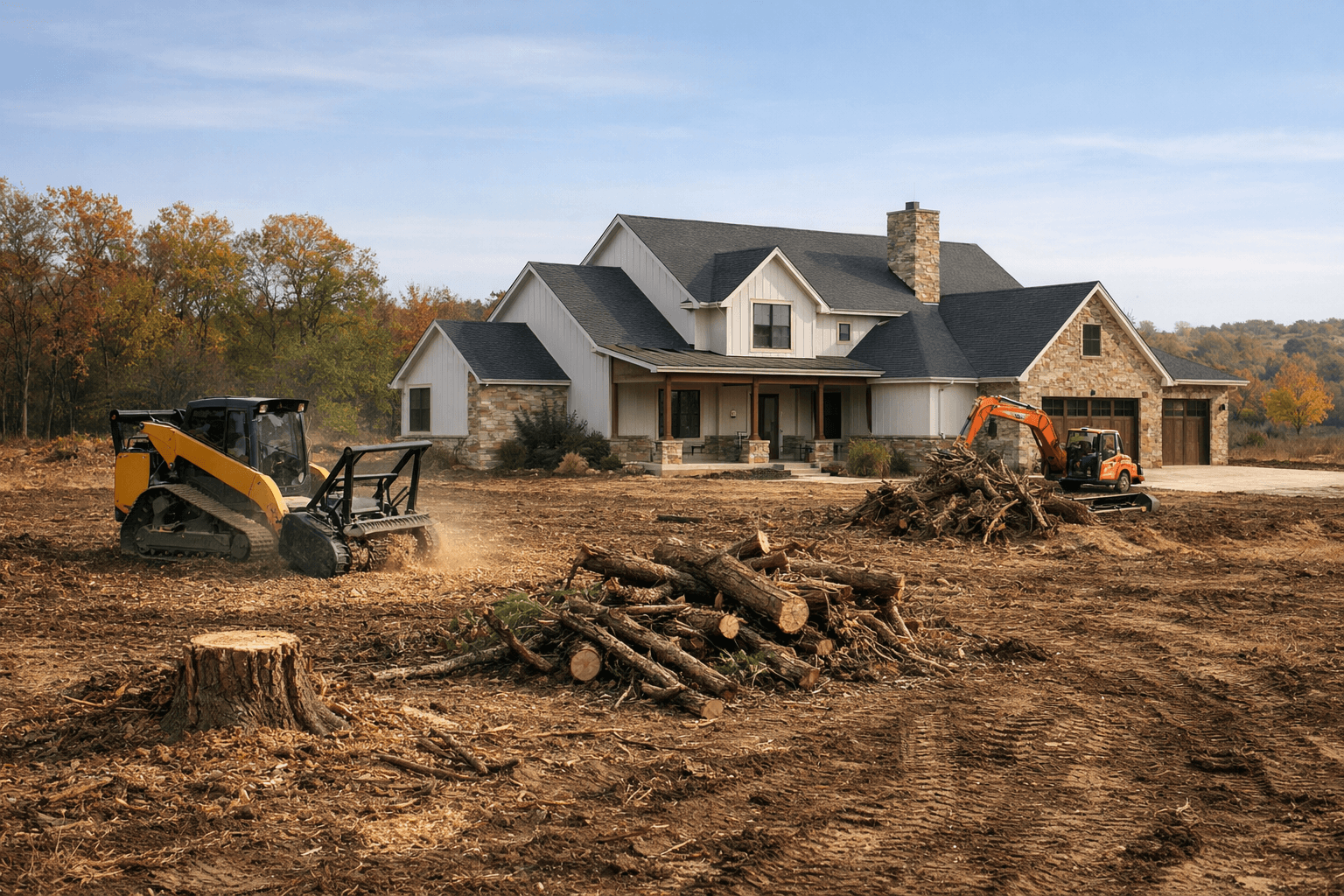
Blog: Fall Land Clearing in Cooke County: Why October Is Ideal
Learn why October is ideal for land clearing in Cooke County, TX. Discover how fall conditions speed up brush removal, equipment efficiency, and site prep for spring building.
Is fall really the best time to clear land in Cooke County?
Yes — October is one of the best months to clear land in Cooke County, TX. The summer heat has broken, the ground is firmer after the dry season, and brush is easier to identify and remove once it starts going dormant. You also avoid the muddy site conditions that come with spring rains, which means equipment moves faster and your project stays on schedule.
What does land clearing in Cooke County actually involve?
Land clearing in Cooke County typically includes brush and cedar removal, tree clearing, stump grinding, root removal, grading, and drainage work. The specific scope depends on your acreage and what you plan to build — a custom home, a barn, a pond, or a pasture. A good crew handles all of it in one mobilization so you're not coordinating three separate contractors on the same piece of ground.
How long does fall land clearing take on a Cooke County property?
Most residential land clearing jobs in Cooke County run anywhere from one day to two weeks, depending on acreage, vegetation density, and what comes after the clearing — grading, pond excavation, or site prep for a home pad. A straightforward 2–5 acre brush removal can often wrap up in two to three days when conditions are right, which fall delivers consistently.
If you've been sitting on a piece of North Texas land and waiting for the right moment to get it cleared, this article lays out exactly why October makes sense — and what to think through before the crew shows up.
Why October Conditions Favor Brush Removal in North Texas
Cooke County summers are brutal. Equipment operators are working in 100-degree heat, the soil bakes hard in some spots and turns to mush in low-lying areas after a storm, and cedar and mesquite are in full leaf — which actually makes it harder to assess what you're dealing with underneath the canopy.
By October, the picture changes. Temperatures drop into the 60s and 70s, which means longer productive days on the machine without heat shutdowns or crew fatigue. The ground firms up after summer's dry stretch, so tracked equipment and skid steers aren't tearing up soil structure the way they can after a wet spring. That matters a lot when you're prepping a home site or a future pond.
Dormant brush is easier to handle. As native grasses and woody brush begin to go dormant in fall, root systems pull back. That makes stump removal and root grubbing more efficient — you're not fighting a fully hydrated root ball the way you would in June. Less resistance means cleaner extraction and faster work.
There's also a practical timing benefit. If you clear in October and get your site graded before winter, you're positioned to break ground on a home, barn, or custom pool in early spring — ahead of the summer construction rush. Families planning a custom home and building project in Gainesville, Muenster, or anywhere across Cooke County know how fast the good build slots fill up.
What Does Fall Land Clearing Set You Up For?
Fall clearing isn't just about removing brush. It's about getting your land ready to become something. Here's what a properly cleared and graded fall site opens up for you:
- Custom home site prep — A cleared, graded pad lets your builder start framing as soon as permits clear in late winter or early spring.
- Pond development — Fall is an ideal time to excavate a stock pond or recreational lake. Drier conditions mean cleaner excavation and better compaction on the dam structure.
- Pasture reclamation — Invasive cedar, mesquite, and prickly pear choke out native grasses. Clearing in fall gives new grass seed time to establish before the growing season.
- Steel building or barn pads — Engineered steel buildings need a properly prepared slab or pier system. A fall grading job sets that foundation work up cleanly.
- Fence line clearing — Running a new fence line through overgrown brush is far easier when the vegetation is dormant and you can see the lay of the land clearly.
Fall vs. Spring: Which Season Wins for Land Clearing in Cooke County?
| Factor | Fall (October) | Spring (March–April) |
|---|---|---|
| Ground conditions | Firm after dry season | Often muddy after rain |
| Brush visibility | Dormant — easy to assess | Full leaf — harder to evaluate |
| Stump removal | Easier — roots pulling back | Harder — root systems fully hydrated |
| Equipment productivity | High — cooler temps, longer days | Variable — weather delays common |
| Build timeline | Spring groundbreaking ready | Summer start, peak contractor demand |
- Ground conditions: firm in fall vs. often muddy in spring
- Brush visibility: dormant and easy to assess in fall vs. full-canopy in spring
- Stump removal: cleaner extraction in fall vs. fighting hydrated root balls in spring
- Equipment productivity: cooler fall temps keep crews moving vs. weather delays in spring
- Build timeline: fall clearing sets up a spring groundbreaking vs. a summer start at peak demand
What to Think Through Before Your Crew Arrives
Getting the most out of a fall clearing job means doing a little homework first. Read through our guide on factors to consider before starting a land clearing job — it covers questions about property lines, easements, utilities, and how your end goal shapes the scope of work.
A few things worth sorting out before you call:
- Know your property corners. Clearing across a line is an expensive mistake.
- Have your land plan in mind, even if it's rough — "future home site," "pond and pasture," or "barn and turnout" gives a clearing crew the context to grade for your purpose, not just remove brush.
- Check whether your county or city requires a clearing permit. In Cooke, Denton, and Grayson counties, requirements vary — J C Boyd manages all of that permitting in-house, so you're not chasing paperwork.
- Think about drainage before clearing starts. Removing vegetation changes how water moves across your land. A crew that understands land clearing and site prep as a system will grade with drainage in mind from the start.
Also worth reading: our post on kicking land clearing on the wrong foot — the mistakes landowners make when they start without a full picture of what the site needs.
Why J C Boyd Is the Right Crew for Cooke County Land Clearing
Cody Boyd didn't come up through a management track. He worked every phase of construction himself before earning his general contractor's license — which means when he looks at your land, he's thinking about what it takes to build on it, not just clear it. That perspective matters when you're spending real money on a property you plan to live on or pass down.
J C Boyd takes on a select number of projects each year — by design. That's not a limitation; it's a commitment to giving each property the attention it deserves. You won't get handed off to a crew you've never met and never see Cody again.
The one-stop-shop model is a genuine advantage on larger rural properties. Land clearing, site grading, pond development, custom home construction, fencing, and engineered steel buildings — it all runs through one team, one contract, one point of contact. For families developing a ranch property or building a lake home at Lake Kiowa, that coordination alone saves months. Learn more about how all those services connect on our full services page.
J C Boyd is licensed and insured — liability coverage and workers' comp on every project, every time. 5-star rated on HomeAdvisor, screened and background verified. Member of NAHB and the Texas Association of Builders.
If you're considering land development across a bigger parcel and want to understand all the moving parts, our post on land development and how to handle the hurdles that come with it is a good place to get oriented.
According to the Texas Department of Agriculture's forestry resources, invasive cedar alone has spread across tens of millions of Texas acres — fall clearing is one of the most effective tools for pushing it back. And per Texas A&M AgriLife Extension, brush management timing directly affects effectiveness and long-term control — dormant-season work produces better results.
Frequently Asked Questions
Do I need a permit to clear land in Cooke County, TX?
It depends on the size of the clearing, proximity to waterways, and whether your property falls inside any city limits. Cooke County itself has minimal restrictions on rural parcels, but if you're near a creek or the land touches a floodplain, additional steps may apply. J C Boyd handles permit research and filing across Cooke, Denton, and Grayson counties, so you don't have to sort that out on your own.
How many acres can be cleared in a single fall project?
A typical residential land clearing project in Cooke County ranges from 1 to 20 acres. Smaller tracts — 1 to 5 acres — often wrap up in two to four days. Larger ranch or development parcels take longer depending on cedar density, slope, and what site prep work follows the clearing. The best way to get a realistic timeline is a free on-site consultation before any work starts.
What happens to the brush and stumps after clearing?
Cleared material is typically chipped, mulched in place, or hauled off depending on your preference and the scope of the job. Mulching is popular on ranch properties because it returns organic matter to the soil. Stumps are ground down below grade. If you're prepping a home site or barn pad, a cleaner removal is usually the right call so grading can proceed without buried debris causing issues later.
Can J C Boyd handle land clearing and the home build on the same property?
Yes — that's one of the main reasons landowners across Cooke County choose J C Boyd. Handling clearing, grading, pond excavation, home construction, fencing, and steel buildings under one roof means the crew that clears your land already understands what's going up on it. There's no miscommunication between a separate clearing contractor and your builder. One team, one plan, start to finish.
Is fall the only good time to clear land in North Texas?
No, but it's consistently the most favorable season for efficiency and results. Winter clearing is possible and sometimes preferred on certain property types. Summer work is harder on equipment and crews, and spring clearing often fights wet ground. Fall hits a sweet spot — cooler temps, firm soil, dormant vegetation — that makes the work cleaner and faster than any other season in North Texas.
Ready to put your Cooke County land to work this fall? Call J C Boyd Custom Builders at 940-368-1882 or reach out online for a free consultation. We respond within one business day, and we're in the office Monday through Friday, 8 to 5, with Saturday appointments available. Let's walk your property together and build a plan that fits what you're trying to build.
About the Author
J C Boyd Custom Builders, LLC
Serving Gainesville, TX and all of North Texas with custom home building, pool construction, and land clearing services. Licensed, insured, and 5-star rated.
Start Your Project
Ready to build your custom home, pool, or prepare your land? Get a free consultation from J C Boyd Custom Builders.
Contact Us940-368-1882Related Articles
Are You Ready to Start Building?
Explore. Dream. Get Inspired.
Let's build your vision together. Contact J C Boyd Custom Builders for a free consultation serving Gainesville, TX and all of North Texas.
Contact Us